Childhood nostalgia
72 of 209 respondents selected nostalgia for childhood as the primary reason people enjoy Chinese Dreamcore.
A mobile AR exploration prototype that turns childhood objects and familiar public spaces into an active memory-collection experience.
I framed the opportunity, conducted the research, designed the product system and visual language, built the Unity AR demo and tested its interaction core in three physical contexts.
A concept-to-interactive prototype in which AR scene activation, 3D item rendering and ManoMotion collect/discard gestures were built and tested; the wider map, library and social ecosystem remains a visual concept.
TARGET USERS
How might familiar real-world places become active portals to childhood memory instead of remaining passive Dreamcore images on a screen?
72 of 209 respondents associated Dreamcore’s appeal with nostalgia for childhood — the largest response group.
Anchor the experience in recognizable objects from users’ formative years.
Four location-specific collections of transformed childhood objects.
Interviewees connected Dreamcore with familiar childhood elements and relief from present-day pressure.
Use real places with autobiographical meaning, not a fully fictional game world.
School, snack street, amusement park and public-square contexts.
Dreamcore is usually consumed passively through short video and streaming content.
Turn nostalgia into a physical act of searching, reaching and collecting.
Location → AR reveal → gesture → collect → memory library loop.
SURVEY · N=209 + INTERVIEWS · N=3
An online survey mapped the emotional appeal of Chinese Dreamcore. Three semi-structured interviews then connected those signals to childhood familiarity, present-day pressure and the value of revisiting memory through place.
72 of 209 respondents selected nostalgia for childhood as the primary reason people enjoy Chinese Dreamcore.
58 of 209 connected its appeal with social change, reinforcing the link between memory and present-day uncertainty.
126 of 183 reported either strong emotional resonance or a brief escape from reality.
INTERVIEW SYNTHESIS · N=3
 01
01“Chinese Dreamcore feels familiar and intimate because it is composed of elements from my childhood. Nostalgia may also be a way of resisting present-day pressure and beautifying memories.”
Design around concrete childhood objects and familiar places, while keeping the experience exploratory rather than prescribing one fixed memory narrative.
The second survey question was shown only to respondents familiar with Chinese Dreamcore, producing 183 valid answers. Percentages below are calculated from the supplied response counts; survey field dates and interview recruitment details were not recorded in the source material.
SYSTEM ARCHITECTURE
The Unity demo proves scene activation, 3D rendering and ManoMotion gesture collection. Character creation, navigation, filters, persistence, library, community, chat and exchange are UX concepts, not shipped functionality.
School, amusement park, snack street and public square define the memory collection.
VISUAL CONCEPTThe mobile camera opens the real-world collection scene.
BUILT & TESTEDLocation-specific childhood objects are placed into the live camera view.
BUILT & TESTEDHand tracking interprets the user’s collection and discard gestures.
BUILT & TESTEDA successful gesture resolves the object-level interaction in the demo.
BUILT & TESTEDFilters, persistence, personal library, chat and exchange extend the proposed loop.
VISUAL CONCEPTDESIGN + BUILD EVIDENCE
The product was intentionally scoped as a working AR interaction demo inside a broader concept experience. Every image below is labelled by its actual completion level.
Users move through a meaningful place, reveal a transformed childhood object, collect it through a hand gesture and gradually assemble a personal memory library.
The proposed mobile flow connects navigation, camera activation, gesture guidance, collection feedback and the personal inventory.
Unity and ManoMotion were combined to recognize the hand, surface an interaction cue and complete the collect gesture against a live camera scene.
Each environment uses a distinct set of remixed objects from the 2000s, making the collection recognizable without reproducing one literal memory.
One live camera scene, rendered memory objects, ManoMotion hand recognition and working collect/discard gestures.
Character creation, real location navigation, filters, saved inventory, community, chat and item exchange.
The demo validates the interaction core, but does not yet prove GPS navigation, persistent collections or reliable recognition across devices, lighting conditions and crowd density.
TECHNICAL FIELD TRIALS
An indoor trial established that the AR objects could remain visible and the collect gesture could be recognized against a controlled, repeated background.
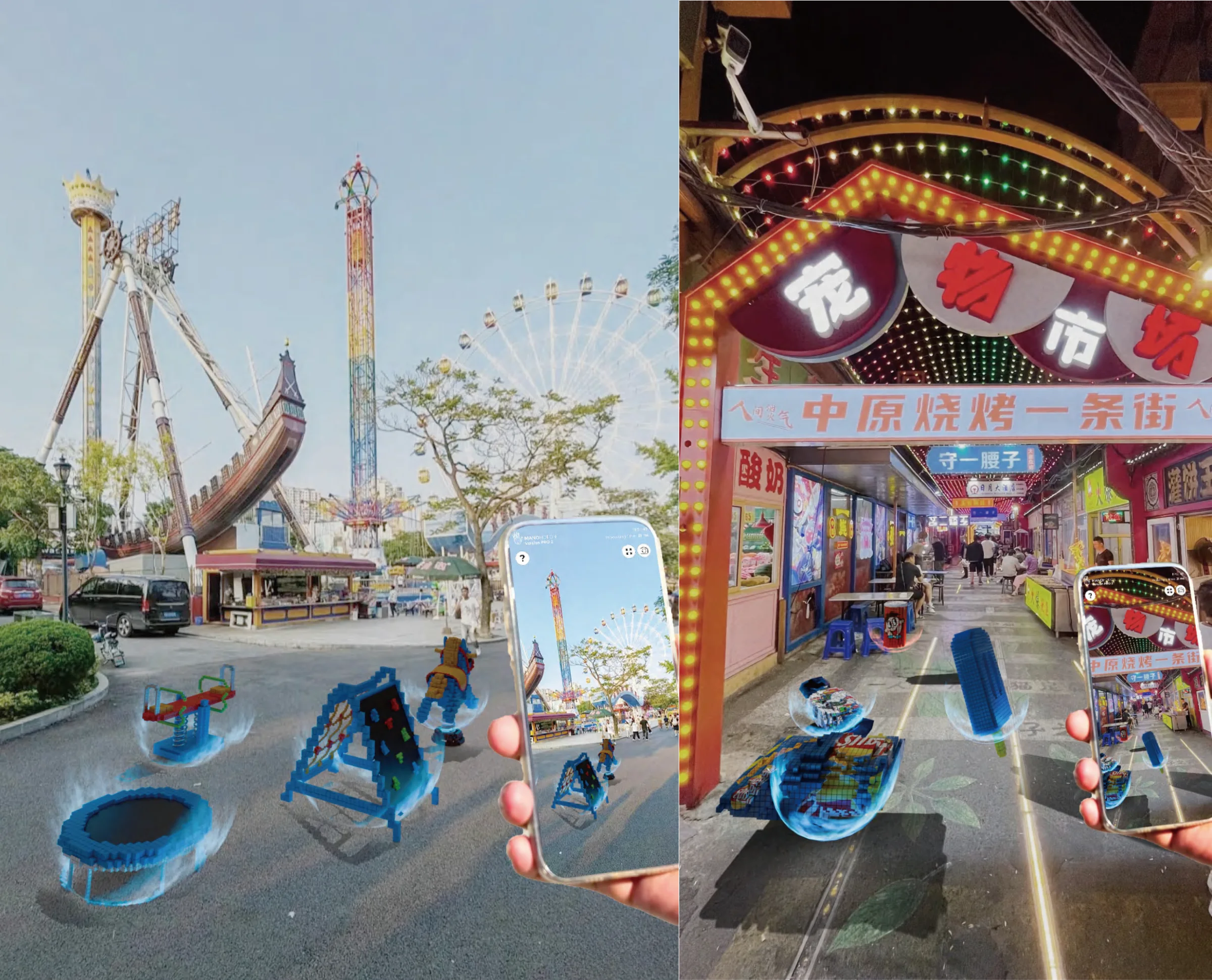
The prototype was taken into a visually dense commercial environment to check whether live objects and hand tracking remained legible amid signage and movement.
A bright outdoor scene tested the core interaction against strong daylight, moving visitors and a larger spatial backdrop.
These trials show that AR rendering and gesture collection can run in three real contexts. Participant-level completion rates, recognition error counts and comparative usability metrics were not recorded, so no behavioral impact is claimed.
Connect one real location trigger to the working AR interaction, add a visible button fallback, then run 5–8 moderated sessions measuring discovery, gesture success, fallback use and whether the collected objects evoke personally meaningful memories.